


Compliance-First Development: Building Compliant Fintech Solutions That Scale
In the fast-paced world of fintech and insurtech, speed to market is often seen as the ultimate competitive advantage. But what if the race to launch is a race towards a cliff? Building a financial or insurance product without a compliance-first mindset is like constructing a skyscraper on a foundation of sand. It may look impressive at first, but it’s destined to crumble under the weight of audits, rework, and regulatory penalties. The goal should not be just to build fintech solutions, but to build compliant fintech solutions from the ground up.
Compliance can’t be a feature you bolt on later. It must be woven into the very fabric of your product’s DNA from the first line of code. This article explores why a compliance-first approach is not just a defensive measure, but a strategic imperative for building secure, scalable, and sustainable compliant fintech solutions.
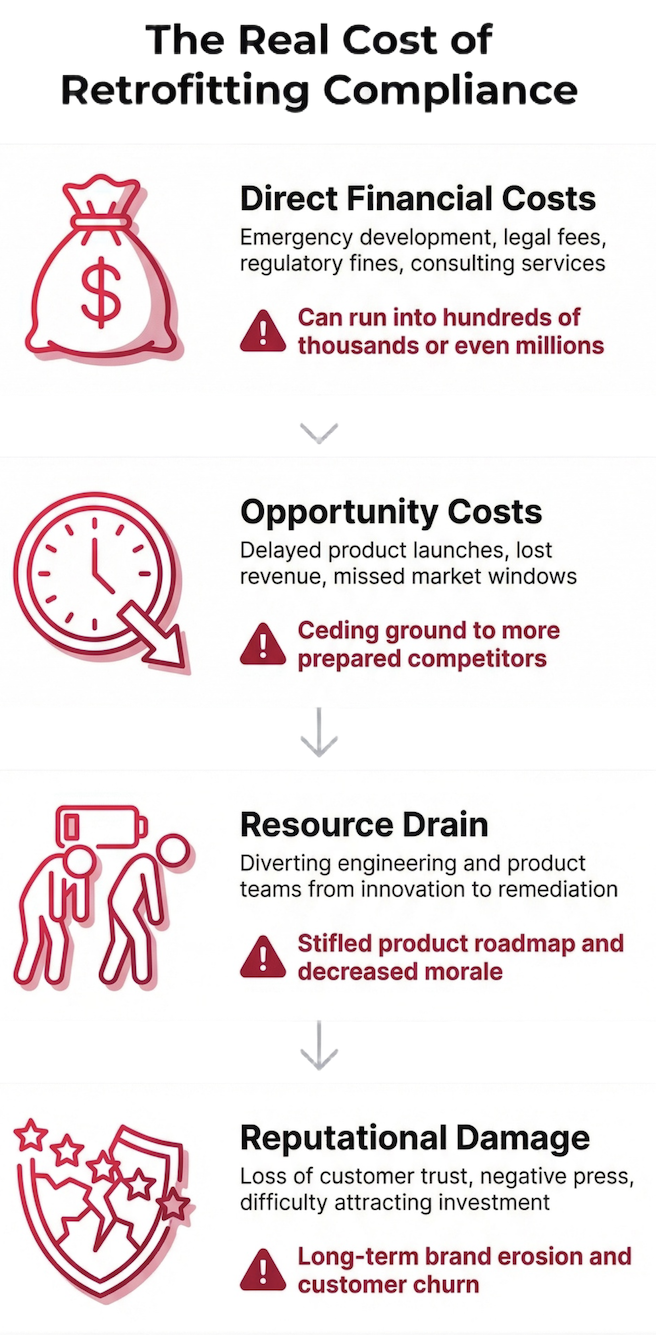
The Real Cost of Retrofitting Compliance
Treating compliance as an afterthought is one of the most expensive mistakes a company can make when developing financial software. The costs aren’t just financial; they ripple across your entire organization, leading to significant delays, resource-draining rework, and failed audits that can bring your growth to a screeching halt. The failure to build compliant fintech solutions from the start has clear and measurable consequences.
Consider the real-world consequences. One automotive manufacturer had to pull their connected car app from the market after an audit revealed data handling issues that had been overlooked for months. The price tag for this oversight was a staggering £180,000 in emergency compliance work and another £40,000 in legal fees, not to mention six weeks of lost revenue while the app was down.
This isn’t an isolated incident. Studies show that retrofitting compliance can be 3 to 5 times more expensive than building it in from the start. For example, integrating GDPR requirements after a product is built can cost over 2.5 times more than designing privacy from day one. These costs don’t even account for the reputational damage and loss of customer trust that inevitably follow a compliance failure.
Key Regulations for Compliant Fintech Solutions
Navigating the regulatory landscape is a complex undertaking, but a few key regulations form the bedrock for creating compliant fintech solutions. Architecting your systems to meet these standards from the outset is non-negotiable.
- GDPR (General Data Protection Regulation): The EU’s landmark data privacy law, GDPR mandates strict rules for how personal data is collected, processed, and stored. It requires a clear legal basis for data processing, robust security measures, and mechanisms for honoring data subject rights. For developers, this means implementing privacy by design, with features like data minimization, encryption, and detailed audit trails.
- PSD2 (Payment Services Directive 2): This EU directive has revolutionized the payments industry by enabling Open Banking. It requires banks to open up their data to third-party providers (with customer consent) and mandates Strong Customer Authentication (SCA) for most online payments. Building a fintech app under PSD2 requires a sophisticated API architecture and multi-factor authentication systems from day one.
- MiFID II (Markets in Financial Instruments Directive II): For fintechs in the investment space, MiFID II imposes extensive requirements around transparency, investor protection, and transaction reporting. This translates to building systems that can handle client categorization, suitability assessments, best execution monitoring, and detailed record-keeping of all communications.
- Solvency II: The cornerstone of insurance regulation in the EU, Solvency II is a risk-based capital regime that dictates how much capital insurers must hold to cover their risks. It is built on three pillars: quantitative requirements (Pillar 1), governance and risk management (Pillar 2), and disclosure and transparency (Pillar 3). For insurtechs, this means developing robust data management systems, risk calculation engines, and automated regulatory reporting capabilities.



Yameo’s Methodology for Compliant Fintech Solutions
At Yameo, we don’t just understand these regulations; we’ve built our entire development process around them. With over 20 years of experience in the trenches of fintech and insurance software development, we know that compliance is the foundation of innovation. Our methodology ensures that regulatory requirements are not a hurdle, but a blueprint for building truly compliant fintech solutions.
This process begins with our Discovery Workshop, a collaborative deep dive where we align your business goals and map them to the regulatory landscape. This isn’t a simple box-ticking exercise; it’s a strategic process where our team of consultants, architects, and business analysts work with you to define the project’s scope, identify potential risks, and establish a clear plan. We leave no stone unturned, ensuring that from the very beginning, your product vision is in lockstep with your compliance obligations.
From there, our compliance-first approach is embedded in every stage of development:
- Audit Trail Architecture from Day One: We design systems with complete traceability in mind. Every critical action, from data access to transaction execution, is logged in an immutable audit trail. This not only prepares you for audits but also provides invaluable business intelligence.
- Data Sovereignty and Encryption Strategies: We implement robust data governance frameworks, ensuring that data is stored and processed in compliance with regional regulations. Advanced encryption, both at rest and in transit, is a standard, not an add-on.
- Automated Compliance Testing: We integrate compliance checks directly into our CI/CD pipeline. This includes automated tests for security vulnerabilities, data privacy rules, and regulatory reporting requirements. By catching potential issues early and often, we dramatically reduce the risk of last-minute surprises.
As a competitive advantage, we recommend and implement best-in-class tools for security and compliance automation, such as HashiCorp Vault for secrets management, SonarQube for static code analysis, and OWASP ZAP for dynamic application security testing. This focus on automation and best-of-breed tooling ensures that compliance is a continuous, repeatable process, not a manual, error-prone one.
Case Study: A Compliant Fintech Solution in Action
Our work with Tellma GmbH, an innovative telepresence solutions provider, perfectly illustrates our compliance-first methodology. Tellma needed a robust and flexible video banking solution that could be rapidly deployed across various IT environments in Germany and Switzerland, two countries with stringent financial regulations. The end goal was a fully compliant fintech solution for the banking sector.
The primary challenge was to build a solution that could handle sensitive banking operations, including Know Your Customer (KYC) procedures, while integrating with multiple third-party systems. From the outset, we architected the solution for compliance.
- KYC and API Integration: We integrated a third-party video identification solution via a secure REST API, ensuring that Tellma’s banking clients could meet their KYC obligations seamlessly. The architecture was designed to be both secure and extensible, allowing for the rapid addition of new services.
- Penetration Testing and Certification: We knew that the financial services sector demands the highest levels of security. Our internal testing team, supplemented by an external security firm, rigorously tested the solution. The result? The platform not only met ISO 27001 standards but also passed the demanding ISAE 3402 penetration testing, a key requirement for many banking organizations.
By building compliance into the core of the video kiosk solution, we enabled Tellma to win deals with 7 banks across Germany and Switzerland, serving over 25,000 end-users per month. This is the power of compliance-first development: it doesn’t slow you down; it accelerates your path to market leadership.
Compliant Kiosk Terminals in Switzerland
The Long-Term Advantage of Compliant Fintech Solutions
A compliance-first approach pays dividends long after your product has launched. By building on a solid regulatory foundation, you unlock a host of long-term strategic advantages for your compliant fintech solutions:
- Easier Audits: When audit trails, data governance, and regulatory reporting are built-in, audits become a routine verification process, not a frantic, all-hands-on-deck fire drill. This can reduce audit preparation time by a significant margin.
- Faster Market Expansion: With a compliant core architecture, expanding into new regions becomes exponentially easier. You can adapt to local regulatory variations without having to re-architect your entire platform.
- Reduced Technical Debt: Retrofitting compliance creates a mountain of technical debt that will slow down future development and increase maintenance costs. A compliance-first approach keeps your codebase clean, maintainable, and agile.
- Enhanced Customer Trust: In a world of constant data breaches, customers are more discerning than ever. A demonstrable commitment to compliance and security becomes a powerful differentiator and a cornerstone of brand trust. This is reflected in our 75% customer return rate—our clients come back because they know we deliver secure, reliable, and compliant solutions on time and within budget.
Interested in exploring Compliant fintech solutions fit for your business?
Interested in exploring Compliant fintech solutions fit for your business? Let’s chat – we love turning complex challenges into powerful digital tools.
